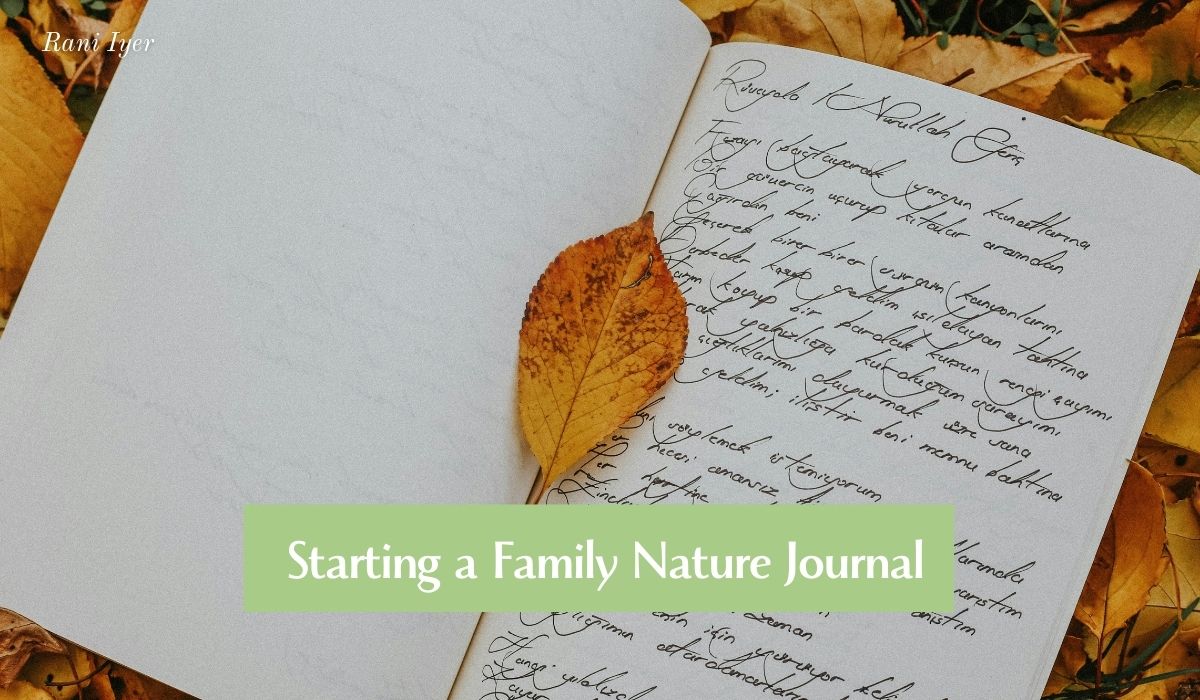
A simple habit-building guide for families who want to connect with nature—right in their own backyard
The Journal That Changed Everything
Last January, my daughter asked me what color the sky was.
We were standing in our backyard, the same patch of grass we’d walked across hundreds of times. I looked up, ready to say “blue,” but stopped. It wasn’t blue. Not really. It was pearl gray with veins of pink, shifting into amber near the horizon. I realized I couldn’t remember the last time I’d actually looked at the sky—truly looked.
That moment sparked something. We grabbed a notebook that afternoon and made our first nature journal entry: “January 14th. Sky = oyster shell + honey.” My daughter added a wobbly circle in orange crayon.
That was 365 days ago. We haven’t missed a single day since.
This isn’t a story about becoming naturalists or mastering wildlife identification. It’s about building a simple daily habit that transformed how our family sees the world right outside our door. And I’m going to show you exactly how to start your own family nature journal—one that actually sticks.
Why Nature Journaling Works for Everyone, Everywhere
Whether you live in downtown Tokyo, suburban Texas, rural Ireland, or coastal Australia, nature is happening around you right now. The beauty of nature journaling isn’t about accessing pristine wilderness—it’s about noticing the wild threads woven through everyday life.
Backyard nature journaling works because:
- It requires zero special equipment (a napkin and pencil count)
- Location doesn’t matter (your doorstep is enough)
- No expertise needed (you’re recording, not identifying)
- Time commitment is tiny (one minute counts)
- Everyone participates equally (no right or wrong observations)
The practice of regularly observing nature—even in small doses, even in ordinary places—has been shown to reduce stress, increase mindfulness, boost creativity, and strengthen family bonds. But the secret? You have to actually do it consistently. And that’s where most nature journals fail.
Understanding Phenology: Nature’s Secret Calendar
Before we dive into the how-to, let’s talk about what makes nature journaling more than just pretty sketches.
Phenology is the study of recurring natural events and their timing. It’s nature’s calendar: when the first robin appears, when the magnolia buds swell, when the fireflies start their evening dance, when frost arrives. Indigenous communities have practiced phenological observation for millennia, reading the land’s rhythms to guide planting, harvesting, and seasonal preparation.
When you keep a nature journal, you’re not just documenting what you see—you’re becoming a phenologist. You’re learning the patterns specific to your place on Earth.
And here’s what makes this magical: phenology is completely local. The nature calendar in your backyard is unique to your microclimate, your ecosystem, your exact patch of planet. No guidebook can tell you when your maple tree will turn scarlet or when your neighborhood owl will start calling. Only observation reveals these secrets.
This is why identification matters less than you think. You don’t need to know that tree is a Quercus rubra to notice when its leaves emerge, change, and fall. The relationship you’re building is with specific living things in a specific place—and that relationship deepens through attention, not Latin names.
Why Observation Beats Identification (And Why This Matters)
We’ve been taught that knowing the names of things equals understanding them. But nature journaling flips this script.
When my son started journaling, he obsessed over identifying every bird. He’d spend fifteen minutes scrolling through apps, frustrated that he couldn’t distinguish a house finch from a purple finch. Meanwhile, the birds kept living their lives, and he missed the whole show—the way they tilted their heads, their feeding patterns, the social dynamics at the feeder.
Observation is the superpower. Identification is just a label.
When you observe first:
- You notice behavior, not just species
- You develop patience and presence
- You spot patterns over time
- You connect emotionally to individual creatures
- You build genuine curiosity that makes later identification meaningful
Start with what you notice: “Small brown bird with spotted chest, hops instead of walks, scratches at ground with both feet simultaneously.” That’s real knowledge. That’s relationship. You can always add the name “towhee” later—but the observation is what matters.
This approach works everywhere because you’re not dependent on having the “right” species around you. Urban sparrows teach observation just as well as rare warblers. The neighbor’s cat crossing the fence is as valid an entry as a fox.
The One-Minute Nature Note: Your Entry Point
Here’s the commitment that actually works: one minute, once a day, any format.
Not “fill a whole page.” Not “create a detailed scientific illustration.” Not “write poetic prose about the transcendent beauty of the natural world.”
One minute. One observation. Done.
This is your sustainable entry point, and it’s the secret to building a habit that lasts beyond January’s enthusiasm.
What a One-Minute Nature Note Looks Like
Option 1: Single Word
“Dripping” (icicles melting from gutter)
Option 2: Quick Sketch
Messy circle with wavy lines = dandelion gone to seed
Option 3: Photo + Caption
Phone snapshot: “First crocus. Northeast corner.”
Option 4: Numbers
“Robins: 7, Sparrows: 12, Crows: 3”
Option 5: Question
“Why do all the bees go to the purple flowers first?”
Option 6: Feeling
“Wind made me laugh today”
The format doesn’t matter. The consistency does.
Building Your Nature Journaling Practice: A Month-by-Month Plan
Week 1: Establish the Routine
Choose your commitment:
- Same time each day (morning coffee, after dinner, bedtime)
- Same location (back porch, kitchen window, garden bench)
- Same trigger (when you let the dog out, when you water plants)
Keep it ridiculously easy:
- Journal lives by the door or in your pocket
- Use whatever’s handy (sticky notes count!)
- Set a phone reminder if needed
First week prompts:
- What’s the first thing you notice today?
- What’s the loudest sound outside?
- Find something smaller than your thumb
- What moved?
- Temperature check: How does the air feel?
- Color hunt: Name three colors you see
- What surprised you?
Week 2: Expand Your Noticing
This week, add one extra element to your one-minute note—but still keep it simple.
Observation challenges:
- Monday: Add time of day to your note
- Tuesday: Include weather conditions
- Wednesday: Note something you smell
- Thursday: Record a sound
- Friday: Sketch one shape you see
- Saturday: Count something
- Sunday: Free choice—just notice
Week 3: Patterns Start Emerging
By week three, something magical happens: you start seeing patterns. Return to the same spot daily and you’ll notice changes.
Pattern-spotting prompts:
- Has anything changed since yesterday?
- What’s different from last week?
- What’s stayed exactly the same?
- What appeared that wasn’t there before?
- What disappeared?
Week 4: Make It Yours
Now that the habit is forming, personalize your practice. What draws you?
Choose your journaling style:
- The Counter: Numbers, tallies, tracking
- The Sketcher: Quick drawings, shapes, doodles
- The Wordsmith: Phrases, descriptions, poetry
- The Photographer: Phone pics with short notes
- The Scientist: Questions, hypotheses, investigations
- The Hybrid: Mix it up based on mood
Creating a Family Nature Journal vs. Individual Books
One question I hear constantly: should we share one journal or each keep our own?
The shared family journal approach:
Pros:
- Builds collective story and memory
- Lower pressure (someone else might contribute if you forget)
- Amazing to look back and see different perspectives on same day
- Creates conversation (“Did you see what Dad wrote about the spider?”)
- One book to maintain
Cons:
- Needs to be accessible to everyone
- Requires some coordination
- Some family members might feel shy about their entries
- Can be chaotic with multiple handwriting styles
The individual journal approach:
Pros:
- Personal ownership and pride
- Freedom to develop individual style
- Can be private if desired
- No competition or comparison
Cons:
- Higher chance someone will abandon theirs
- Misses collective story element
- More items to keep track of
My recommendation? Start with a shared family journal for the first month. If someone (especially kids ages 8+) wants their own, great—let them branch off. But having one central journal with everyone’s contributions creates momentum and accountability. Plus, it becomes an incredible family artifact.
Starter Template Library: Different Learning Styles Welcome
Not everyone journals the same way. Here are templates for different approaches—use what works for you.
Template 1: The Quick Capture
Date: _______
Time: _______
Weather: _______
I noticed: _______________________________
Template 2: The Sensory Scanner
Date: _______
I saw: _______
I heard: _______
I smelled: _______
I felt: _______
Template 3: The Counter’s Log
Date: _______
Species/Item | Count
___________|_____
___________|_____
___________|_____
Notes: _______
Template 4: The Sketcher’s Space
Date: _______
[Large blank space for drawing]
Name/Description: _______
Template 5: The Wonder Keeper
Date: _______
I wonder: _______________________________
I think: ________________________________
I’ll look for: ____________________________
Template 6: The Seasonal Tracker
Month: _______
First seen: _______
Peak: _______
Last seen: _______
Notes: _______
Pro tip: Don’t overthink this. A blank notebook works perfectly. Templates are helpful for structure, but they’re not required. Some of our best entries are scribbled on the back of receipts.
Monthly Prompt Calendar: Your Year of Noticing
Stuck on what to observe? Use these monthly themes and weekly prompts to guide your attention.
January: Stillness & Survival
- Week 1: What’s alive right now?
- Week 2: Signs of animals (tracks, scat, disturbed snow)
- Week 3: Winter bird behavior
- Week 4: Evergreens (what stays green and why?)
February: Subtle Changes
- Week 1: Light (how is daylight changing?)
- Week 2: First signs of spring
- Week 3: Winter sounds
- Week 4: Ice and frost patterns
March: Awakening
- Week 1: Buds and swelling
- Week 2: First flowers
- Week 3: Returning birds
- Week 4: Amphibian sounds
April: Explosion
- Week 1: Trees leafing out
- Week 2: Spring wildflowers
- Week 3: Insect emergence
- Week 4: Nest building
May: Abundance
- Week 1: Baby animals
- Week 2: Pollinator activity
- Week 3: Bird songs (dawn chorus)
- Week 4: Lawn “weeds” in bloom
June: Peak Growth
- Week 1: Shadow patterns
- Week 2: Nocturnal life (moths, bats, fireflies)
- Week 3: Storm watching
- Week 4: Longest day observations
July: Summer Rhythms
- Week 1: Heat adaptations (how things cope)
- Week 2: Fruit formation
- Week 3: Insect sounds (cicadas, crickets)
- Week 4: Summer stars
August: Transitions Begin
- Week 1: First signs of autumn
- Week 2: Seed dispersal methods
- Week 3: Migrating birds
- Week 4: Changing light quality
September: Harvest & Preparation
- Week 1: Ripening and falling
- Week 2: Squirrel behavior
- Week 3: Autumn colors starting
- Week 4: Cool morning observations
October: Peak Transformation
- Week 1: Color change progression
- Week 2: Leaf fall patterns
- Week 3: Fungi and mushrooms
- Week 4: Animal preparations for winter
November: Quieting Down
- Week 1: Bare branches revealed
- Week 2: What’s still active?
- Week 3: First frost effects
- Week 4: Winter bird arrivals
December: Deep Rest
- Week 1: Evergreen variations
- Week 2: Animal tracks in snow
- Week 3: Winter constellations
- Week 4: Solstice reflections
Real Examples: Day 1 Journal Pages from Around the World
Nothing inspires like seeing how others begin. Here are real first entries from families who’ve started nature journaling:
From Melbourne, Australia: “Jan 3rd, 6:47am. Kookaburra on the fence post. Same one as yesterday? Laughed three times then flew north. Rainbow lorikeets mobbing neighbor’s grevillea—counted at least 15. Hot already—38°C forecast.”
From Portland, Oregon, USA: “March 15. Rain (obviously). Counted drops on window—gave up at 127. One slug on sidewalk, metallic bronze colored. Smells like wet earth and cedar.”
From Yorkshire, England: “April 2nd. Evening. Found: 7 daisies fully open in lawn. Blackbird singing from TV aerial 6:32pm exactly. Still light at 7:15! Spring is winning.”
From Toronto, Canada: “February 9. -12°C. Chickadee at feeder = 23 visits in 10 minutes. Small black-capped. Makes me feel less cold just watching it. How does something so tiny survive this?”
From Mumbai, India: “July 22. Monsoon day 12. Three crows sharing one branch, huddled together. Watched 6 minutes—didn’t move except to shake water off. Gulmohur tree losing red flowers in sheets. Petals covering street like carpet.”
From suburban São Paulo, Brazil: “August 30. 7am. Sabiá-laranjeira singing—woke us up! Nest in mango tree? Jasmine blooming = entire garden smells sweet. Temperature 19°C (cool morning!). First butterflies at 8:15.”
Notice: no artistic skill required. No expensive equipment. No exotic location. Just attention, honesty, and a few words or marks on paper.
Overcoming Common Obstacles
Let’s troubleshoot the things that derail nature journaling practices:
“I forget every day”
Solution: Attach journaling to an existing habit. Put journal in the path of something you already do daily. Journal + coffee mug. Journal + pet food. Journal + car keys.
“I don’t know what to write”
Solution: You’re trying too hard. Write the laziest, easiest observation possible. “Cloudy.” That counts. Tomorrow you’ll notice more.
“My kids won’t participate”
Solution: Stop asking them to. Just do it yourself, out loud. “Huh, the leaves on that tree are turning yellow from the top down—I wonder why?” Curiosity is contagious. Give it three weeks. Make no demands.
“I missed three days and feel like I failed”
Solution: Missed days don’t negate previous days. You didn’t “break the streak”—you just had three unrecorded days. Today is Day 1 again. Every day is Day 1 if you need it to be.
“Nothing interesting happens in my yard”
Solution: This is impossible. You haven’t looked closely enough yet. I guarantee something is eating something, growing, decomposing, moving, changing, or adapting right now within 20 feet of you. The interest isn’t in the yard—it’s in your attention.
“I can’t draw”
Solution: Neither can I. My “bird” looks like a lumpy football with a triangle. Draw anyway. The drawing is for noticing, not for displaying. And skill comes with practice—my lumpy footballs have gotten slightly less lumpy over 365 days.
“I don’t have nature where I live”
Solution: Yes, you do. Nature isn’t scenery—it’s process. Weeds in sidewalk cracks. Pigeons. Clouds. Ants. Moss. Spider webs. The moon. Weather. Shadows. If you’re on Earth, you have nature. Urban nature journaling is its own rich practice.
Making It Stick: The Relationship Over Data Principle
Here’s what I wish someone had told me when we started: this isn’t about accumulating data. It’s about building relationship.
You’re not trying to create a scientifically accurate record (though you might accidentally do that). You’re not training to be a wildlife expert (though you might become one). You’re not producing art (though you might create it).
You’re practicing relationship.
Relationship with place. With season. With other-than-human life. With your family. With your own capacity to slow down and notice.
Some days your entry will be profound. Many days it will be mundane. Both matter equally. The discipline of showing up—that’s what transforms you.
After a year of daily noticing, here’s what changed for us:
- We know our yard’s rhythms intimately now
- We’ve met our wild neighbors (and named several)
- We spot changes instantly that we’d have missed before
- We talk more, together, about what we observe
- We feel more connected to where we live
- We have a document of an entire year that we’ll treasure forever
But mostly? We just feel more awake to the world.
Your Nature Journaling Toolkit
Essential supplies (pick one):
- Notebook (any kind) + pen
- Stack of index cards + rubber band
- Notes app on phone
- Voice memos
- Cheap sketchbook + pencil
- Back of junk mail envelopes
Optional but fun:
- Colored pencils for sketching
- Pocket magnifying glass
- Binoculars
- Field guides (after you start, not before)
- Watercolors
- Nature journal community (local or online)
Not required:
- Expensive gear
- Artistic ability
- Scientific knowledge
- Perfect consistency
- Instagram-worthy entries
Starting Right Now: Your First Entry
Stop reading. Stand up. Look outside your nearest window. Spend sixty seconds just looking.
What’s the first specific thing you notice? Not “trees” but “three birds in the top of the oak tree, all facing west.” Not “nice day” but “sun making the spider web glow silver between the fence posts.”
Write that down. Add today’s date.
Congratulations. You’re a nature journalist now.
Tomorrow, do it again. Same window, same minute, different observation.
That’s it. That’s the practice.
Join the Journey: Monthly Prompts & Community
Nature journaling is better together. While your observations are personal to your place, sharing the practice creates encouragement and inspiration.
Get monthly journaling prompts, seasonal observation challenges, and inspiration delivered straight to your inbox:
You’ll receive:
- Curated monthly observation themes
- Seasonal phenomena to watch for (customizable by hemisphere)
- Creative journaling techniques and variations
- Reader-submitted journal pages and stories
- Phenology prompts specific to your region
- Tips for sustaining your practice
- Nature journaling challenges with our global community
Plus, you’ll get access to our downloadable starter pack: 12 journal page templates, a phenology tracking sheet, and a troubleshooting guide for common obstacles.
Whether you’re in week one or year ten of your practice, you’re welcome here.
The Gift of Paying Attention
Last week, my daughter—the one who asked about the sky’s color—pointed out that the robin pair nesting in our lilac bush was carrying food to the nest every 6-7 minutes. She’d timed it. She’d noticed that one parent (the male, she thinks, based on coloring) does more hunting while the other guards the nest more.
She’s nine. She learned this not from a documentary or a book, but from watching. From caring. From showing up to our backyard every day for a year with her eyes open.
This is what nature journaling gives us: the gift of paying attention in a world designed for distraction.
You don’t need a mountain vista or a pristine forest. You don’t need expertise or expensive equipment. You don’t need hours of free time or artistic talent.
You just need one minute, one observation, one day at a time.
The world is unfolding right outside your door. It’s been there all along, waiting for you to notice.
Your nature journal is how you notice back.
Start Today: One Minute, One Note
Today is the perfect day to begin. Not January 1st. Not Monday. Not when you’ve bought the perfect journal or learned to identify birds or organized your schedule better.
Today.
Step outside—or look outside—for one minute. Notice one thing. Write it down.
Tomorrow, do it again.
365 days from now, you’ll have a record of a year lived in connection with your place on this planet. You’ll have stories. Patterns. Relationships. Wonder.
But more than that: you’ll have practiced the revolutionary act of paying attention.
In a world hungry for our focus, for our worry, for our frantic energy—choosing to spend one minute a day noticing a bird, a leaf, a shadow, the color of the sky is a quiet rebellion.
It says: This matters. This small moment, this small creature, this small patch of Earth—this matters.
And so do you, noticing it.
Welcome to your year of noticing. Your backyard is waiting.
What will you notice today? Share your first nature journal entry in the comments below—we’d love to see how you begin.