The text message arrived at 8:47 AM on a Tuesday in January: “Too cold for the park today. Maybe this weekend if it warms up?”
I stared at my phone, then at the thermometer outside my kitchen window. Thirty-eight degrees Fahrenheit. Not even freezing.
This is the message I’ve received, in various forms, from hundreds of parents over the past decade. Too cold. Too wet. Too windy. Too muddy. Too dark. The litany of “too” has created an entire generation of children who experience winter primarily through double-paned glass.
And we wonder why our kids can’t focus.
Here’s what I’m about to tell you, and it’s going to sound absurd until you understand the neuroscience behind it: January is the single best month for your child’s brain development. Not spring. Not those perfect 72-degree days in May. January. Right now. With all its cold, wet, inhospitable glory.
The problem isn’t the weather. It’s that we’ve forgotten how to read it.
The Disruption You Didn’t See Coming
We’ve created a catastrophic comfort bubble around childhood, and it’s suffocating our children’s developing brains.
The average American child now spends less time outside than a maximum-security prisoner. That’s not hyperbole—that’s data from a study comparing children’s outdoor time with prison recreation requirements. And in winter, that number drops even further. Some children go weeks without feeling unfiltered cold air on their faces.
Meanwhile, ADHD diagnoses have increased by 42% in the last eight years. Anxiety disorders in children have doubled. Sensory processing issues that were once rare are now ubiquitous. And we’re searching for answers in therapy offices, medication protocols, and behavioral interventions when the answer is standing right outside our front door, waiting.
Your child’s brain is designed—literally, evolutionarily wired—to develop in response to environmental challenge. And we’ve removed nearly all of it.
Winter isn’t the problem. Winter is the solution we’ve been too comfortable to see.
What Cold Air Does to a Developing Brain (And Why Your Pediatrician Probably Won’t Tell You)
Let me explain what happens when a child steps outside into 35-degree air.
Within seconds, thermoreceptors in their skin activate. These aren’t just temperature sensors—they’re direct highways to the brain’s attention centers. Cold stimulation triggers the release of norepinephrine, a neurotransmitter that sharpens focus, enhances memory consolidation, and regulates mood. It’s the same neurochemical that ADHD medications attempt to modulate, except this version comes from the body’s natural response to environmental stimulation.
But here’s where it gets interesting.
When a child moves through cold air—running, jumping, climbing—their body initiates a complex thermoregulation process. They have to maintain core temperature while their extremities are challenged by cold. This isn’t just “bundling up and dealing with it.” This is their autonomic nervous system learning to regulate, adapt, and respond to real-time environmental feedback.
This is precisely the kind of self-regulation practice that no app, no worksheet, and no breathing exercise can replicate.
The vagus nerve, which controls everything from emotional regulation to digestion to social engagement, gets stronger through this kind of environmental challenge. Children who regularly experience temperature variation show improved heart rate variability—a key marker of nervous system resilience. They literally build a more adaptable stress-response system.
And we’re keeping them inside because it’s “too cold.”
The Physics of Winter: A Sensory Feast Your Child Is Missing
Now let’s talk about what winter actually offers that no other season can provide.
Ice. Snow. Frost. Frozen puddles. These aren’t obstacles to overcome—they’re complex physics laboratories that children’s brains are starving for.
When a child steps on a frozen puddle and hears it crack, they’re experiencing immediate cause-and-effect feedback. Their proprioceptive system (body awareness in space) is getting real-time data about weight distribution, force, and structural integrity. Their auditory system is processing the sound of ice fracturing. Their visual system is watching the patterns spread across the surface.
This is multisensory integration at its finest. And it’s happening organically, without a single flashcard or lesson plan.
Snow offers something even more remarkable: constantly changing texture. Fresh powder, packed snow, ice crust, slush—each variation requires different motor planning, different force calibration, different balance strategies. A child walking through varied snow conditions is solving complex proprioceptive puzzles with every step.
You cannot replicate this in a gym. You cannot buy it in a sensory bin. You cannot download it.
The physical world is the ultimate occupational therapy, and winter provides the highest difficulty setting. Which is exactly what developing brains need.
Why “Staying Warm While Active” Is the Resilience Training We’ve Abandoned
Here’s something we’ve lost in the comfort era: the profound developmental value of thermoregulation.
When children play actively in cold weather—running, building, exploring—they have to learn something extraordinary. They have to maintain enough movement to stay warm, but not so much that they overheat in their layers. They have to read their own body’s signals. They have to make real-time adjustments.
This is executive function in action. Planning, monitoring, adjusting, problem-solving.
A child who says “I’m getting too hot, I need to take off my jacket” is practicing interoception—the ability to read internal body signals. A child who notices their fingers getting cold and decides to run around more is practicing agency and self-advocacy.
These are the exact skills that children are struggling with in record numbers. And we’re trying to teach them through social stories and visual schedules when we could be teaching them through the simple act of dressing for weather and going outside.
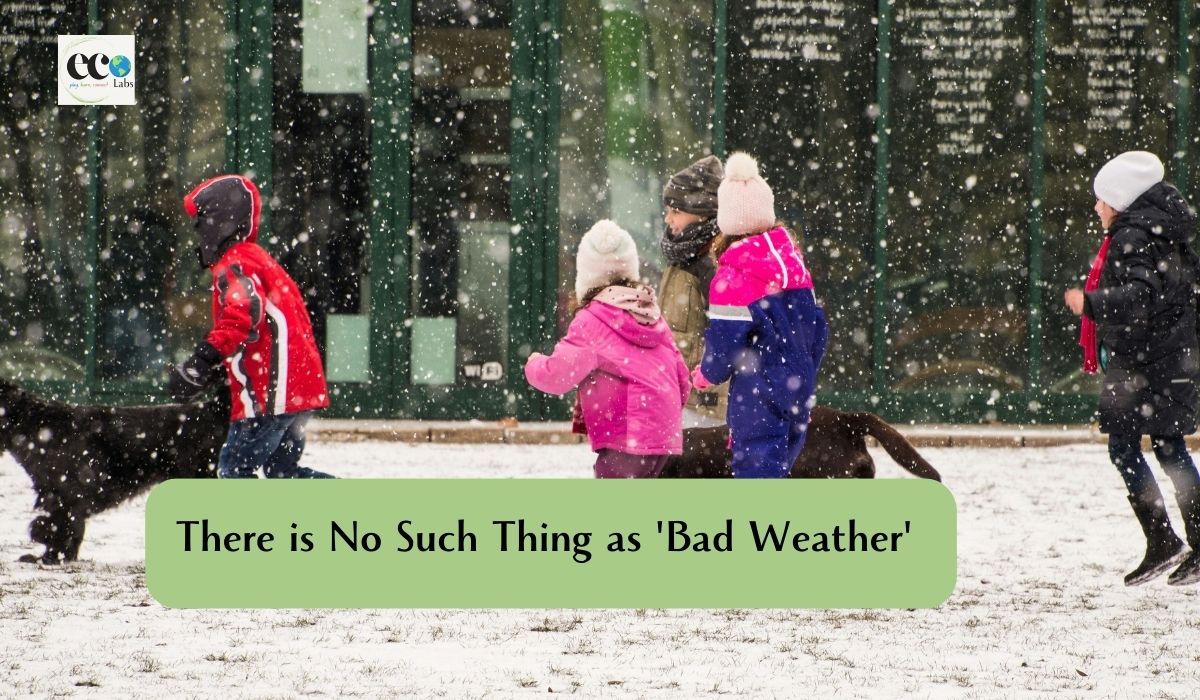
The Scandinavian countries have known this for generations. In Norway, the saying is “Det finnes ikke dårlig vær, bare dårlige klær”—there is no such thing as bad weather, only bad clothing. Swedish preschools conduct outdoor education in all weather, often in temperatures well below freezing.
And what do we see in these countries? Lower rates of childhood obesity. Lower rates of ADHD. Higher rates of resilience, independence, and emotional regulation.
It’s not genetics. It’s ecoliteracy.
Three Winter Wins That Will Change How You See January
Alright. Enough theory. Let’s get practical.
You’re not going to become Norwegian overnight. You don’t need to. You just need three simple experiences that will rewire how your child—and you—perceive winter.
Winter Win #1: The Animal Print Investigation
After rain, snow, or frost, tracks appear that are invisible in summer. Mud holds footprints. Snow reveals pathways. Even frost on grass shows where animals have walked.
Hand your child a phone or camera. Give them one job: find evidence of animals you can’t see.
What you’re really doing: training observational skills, pattern recognition, and sustained attention. They’re reading a landscape, following clues, building a narrative from evidence. This is literacy—not the book kind, the world kind.
The first time my daughter found a line of deer tracks crossing our yard, then followed them to where the deer had bedded down in leaves behind the shed, she talked about it for weeks. She drew maps. She went out every morning to see if new tracks appeared.
That’s intrinsic motivation. That’s a child whose attention is anchored in genuine curiosity.
Winter Win #2: Frozen Bubble Science
When temperatures drop below freezing, soap bubbles freeze in mid-air. The crystallization patterns are extraordinary—fractal ice formations spreading across the bubble surface.
You need: bubble solution, a wand, and temperature below 32°F (0°C). Blow bubbles. Watch them freeze. Let your child catch them, observe them, experiment with them.
What you’re really doing: Direct observation of states of matter. Real-time chemistry. Patience practice (bubbles freeze at different rates depending on temperature and humidity). And pure wonder, which is the foundation of all learning.
My students have used straws to blow bubbles onto snow and watched them freeze into perfect hemispheres. They’ve timed how long different solutions take to crystallize. They’ve photographed the ice crystal patterns with macro lenses.
Not one of them needed me to explain why this was interesting. The phenomenon did the teaching.
Winter Win #3: The Mud Kitchen Redux
You thought mud kitchens were a spring activity? Winter mud is an entirely different sensory experience—denser, colder, sometimes half-frozen. Add ice chunks, frozen leaves, snow, slush.
The engineering challenges multiply. How do you build when your materials are partially frozen? How do you mix when water keeps trying to turn solid?
What you’re really doing: complex problem-solving under challenging conditions. Adaptive thinking. Sensory integration that includes genuine temperature challenge, not room-temperature play dough.
And here’s the secret: children in winter mud get dirty, get cold, come inside, warm up, and immediately want to go back out. They’re building tolerance for discomfort. They’re learning that cold is temporary, manageable, and often worth it.
That’s resilience. Not the theoretical kind. The lived kind.
The Truth We’re Not Saying Out Loud
Here’s what nobody wants to admit: we’re keeping children inside because we don’t want to be uncomfortable. We’ve projected our own temperature preferences, our own aversion to wet and cold and mud, onto our children and called it protection.
But children don’t need protection from weather. They need exposure to it.
The rise in childhood anxiety correlates almost perfectly with the decline in unsupervised outdoor play and environmental challenge. We’ve bubble-wrapped childhood and then expressed surprise when children can’t regulate their emotions, can’t tolerate frustration, can’t focus for more than ninety seconds.
We medicate attention problems while removing every environmental factor that builds attention naturally.
I’m not anti-intervention. I’m anti-ignoring the obvious.
Your child’s brain is supposed to develop in conversation with the physical world—with real temperature, real texture, real cause and effect. When we remove that conversation, we don’t just lose nature connection. We lose neural development.
The 7-Day Reset: What Changes When You Stop Waiting for Spring
I’m launching something at the end of this month, and I need you to know about it now because it requires one thing from you that’s increasingly rare: commitment to discomfort.
The 7-Day Outdoor Reset isn’t about nature crafts or scavenger hunts. It’s about systematically reintroducing your child’s brain to the environmental input it’s been missing. Seven days. Real weather. Measurable changes in focus, regulation, and resilience.
You’re going to get:
- Daily “weather challenges” calibrated to your actual climate
- The exact clothing systems that make winter outdoor time sustainable (because yes, gear matters)
- Video demonstrations of what thermoregulation practice actually looks like
- A framework for reading your child’s sensory responses to cold, wet, and wind
- Documentation tools to track attention and behavior changes
But here’s the real value: you’re going to stop seeing winter as something to survive and start seeing it as the cognitive development opportunity it actually is.
The parents who did the beta version last January reported something I didn’t expect. They said it changed them more than their kids. They stopped negotiating with weather. They stopped waiting for conditions to be perfect. They stopped using temperature as an excuse.
And their children responded by becoming more focused, more regulated, and more confident than any amount of indoor intervention had achieved.
Don’t Wait for Spring to Reclaim Your Child’s Focus
We’re four weeks into January. In most of the Northern Hemisphere, we have at least six more weeks of real winter. Maybe eight. Maybe ten.
You can spend that time inside, watching your child’s screen time creep up and their attention span creep down, telling yourself you’ll get outside when it warms up.
Or you can start tomorrow.
The 7-Day Reset starts February 10th. Early registration opens this Friday.
This isn’t about becoming a nature educator or a wilderness expert. This is about recovering the ecoliteracy that every human culture except modern industrialized ones has maintained: the knowledge that children need weather, need temperature challenge, need physical environmental feedback to develop properly.
Your child doesn’t need perfect weather.
They need you to stop treating winter like an enemy and start treating it like the developmental asset it is.
Reply to this post.
Send us an email.
Because there is no such thing as bad weather.
Only adults who’ve forgotten how to dress for it.
The early bird price ends Monday 9th. After that, you’re paying for spring when you could be using winter.